
Locking your ops to one AI model is an expensive habit
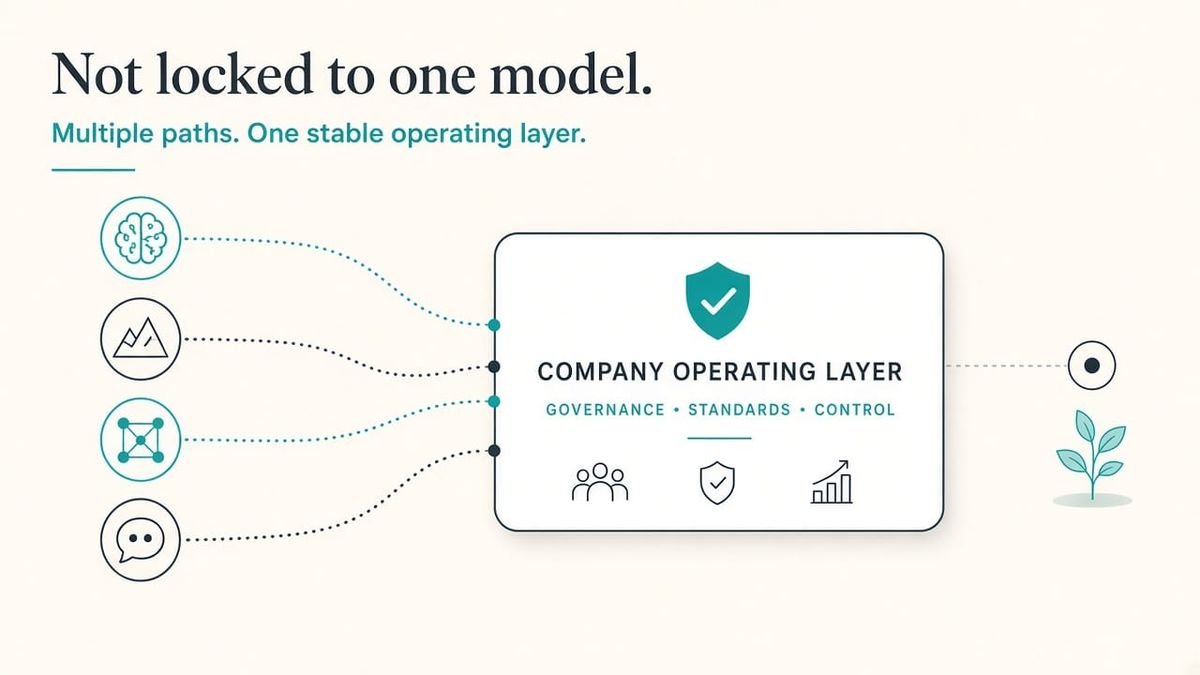
Treat models as swappable workers — keep company memory and approval boundaries in a layer you own.
The stack that only works with one brain
It usually starts with a clean win. One model drafts well. The team builds prompts around it. Workflows route everything through the same endpoint. Staff learn its quirks. Memory and “the way we do things” quietly settle inside that provider’s habits. For a while it feels like progress: fewer tools, one place to look, one style to trust. Then the price changes. Or quality dips on a job that used to be easy. Or a different model is clearly better for research, coding, summarising or customer tone. Or access rules shift overnight. Suddenly the question is not “which model is best?” It is “how much of our business is welded to this one?” That is lock-in. It looks like simplicity and behaves like a single point of failure with a monthly invoice.
Reframe: the model is a worker, not the operating system
A model should be treated like a capable contractor: strong at some jobs, weaker at others, replaceable when the market or the work changes. Company memory should not live inside that contractor. Approval boundaries should not either. Ownership of decisions, customer context, hand-offs and audit trails belong to the business — in a layer that stays stable when the model changes. If swapping models means rewriting prompts, rewiring workflows, retraining staff habits and rebuilding how approvals are recorded, you did not design operations — you rented a bottleneck. The standard is not “pick the best model once.” The standard is “can we change models without losing memory, ownership or control?”
What lock-in actually costs
When ops are fused to one model, several costs show up — often after the demo, once the stack is already live. Switching becomes a rebuild. Prompts are tuned to one behaviour. Evaluations assume one output shape. Routing and fallbacks are hard-coded. Staff workarounds become informal policy. Changing providers then means a project, not a configuration change. That delay is the tax. One outage or quality dip hits everything. A single-model stack is a single point of failure. When that model slows, degrades or becomes unavailable, drafting, triage, research and customer-adjacent work can stall together. Model diversity is not fashion; it is operational resilience. Vendor and pricing risk compound. If leaving is hard, price rises and policy shifts land harder. Negotiating power shrinks when the alternative is months of rework. Lock-in turns a supplier choice into dependence. The wrong brain does the job. Not every task needs the same model. Cheap, fast models can handle classification and extraction. Stronger models may suit judgement-heavy drafts. Specialists may fit code, long context or tone. Lock-in forces one brain onto every job and calls it standardisation. Memory and approvals get tangled with the vendor. When “what we know” and “who said yes” live as side effects of one model’s history or tool chain, governance becomes fragile. You cannot own the process if it only exists inside one supplier’s session. The deeper issue is design. If the model is the system of record for how work runs, the business has outsourced its operating layer without noticing.
Practical standards for model-agnostic ops
A reliable AI operating design keeps models interchangeable behind stable memory and approval boundaries. 1. Separate the model from company memory. Store customer state, decisions, policies, prior outcomes and working notes in a business-owned layer. The model may read that context; it should not be the only place it lives. If the model disappears tomorrow, the business should still know what was true, what was promised and what is pending. 2. Keep approval boundaries model-agnostic. Who can approve a send, a live change, a refund path or a customer commitment should not depend on which model drafted the work. Confirm gates, owners and audit records sit above the model. Swap the worker; keep the gate. 3. Route by job type, not by habit. Define which classes of work prefer which model — and when a fallback is allowed. Classification, drafting, research, code assist and customer tone often deserve different defaults. Habit (“we always use X”) is not a routing policy. 4. Measure swap readiness. Ask regularly: if we changed primary models next month, what would break? List prompts, workflows, evaluations, integrations and staff routines that assume one provider. Anything that cannot move without a rebuild is lock-in debt. Reduce it on purpose. 5. Own the audit trail across models. A manager should reconstruct what was asked, which model ran, what context was used, who approved the outcome and what changed in the record. Model choice should be a logged detail, not the invisible spine of the process.
Five questions before you deepen a single-model stack
Before you pour more workflows into one provider, answer: 1. Where does company memory live if this model is switched off tomorrow? 2. Which approval boundaries stay intact if we change models next quarter? 3. What jobs are we forcing through the wrong brain because “it is what we use”? 4. How expensive is a swap in time, rework and staff relearning — not just API keys? 5. Who owns the operating layer: the business, or the vendor session? If those answers are fuzzy, you may be scaling convenience into dependence. I treat this as a governance and ownership question, not a model-benchmark debate. The business needs a stable layer for memory and approvals so models can be chosen and replaced for the job at hand.
Walter POV: swap the model, keep the company
At Walter, I am focused on helping businesses run AI work with clearer ownership, shared context and visible hand-offs. Model choice sits inside that design; it should not define it. A useful assistant can draft, summarise and suggest. A trustworthy operating layer decides what memory is authoritative, who must approve irreversible actions, and how work moves between people and systems — whether today’s model is last quarter’s favourite or next quarter’s replacement. Speed still matters. Put flexibility where the market moves — at the model — and stability where the business must stay coherent: memory, ownership and approval boundaries.
If your ops only work with one AI model, treat that as a design smell, not a finished architecture. Separate models from company memory. Keep confirm gates and owners above the vendor. Route by job type. Track swap readiness like debt. Log model choice without making it the system of record. Do that, and changing models becomes an operational decision rather than a rebuild of how the company remembers, decides and commits. Join the waitlist at https://hirewalter.ai/



