
Your AI should ask before it emails a customer
Outbound AI should not reach a customer until someone has given a clear, recorded yes.
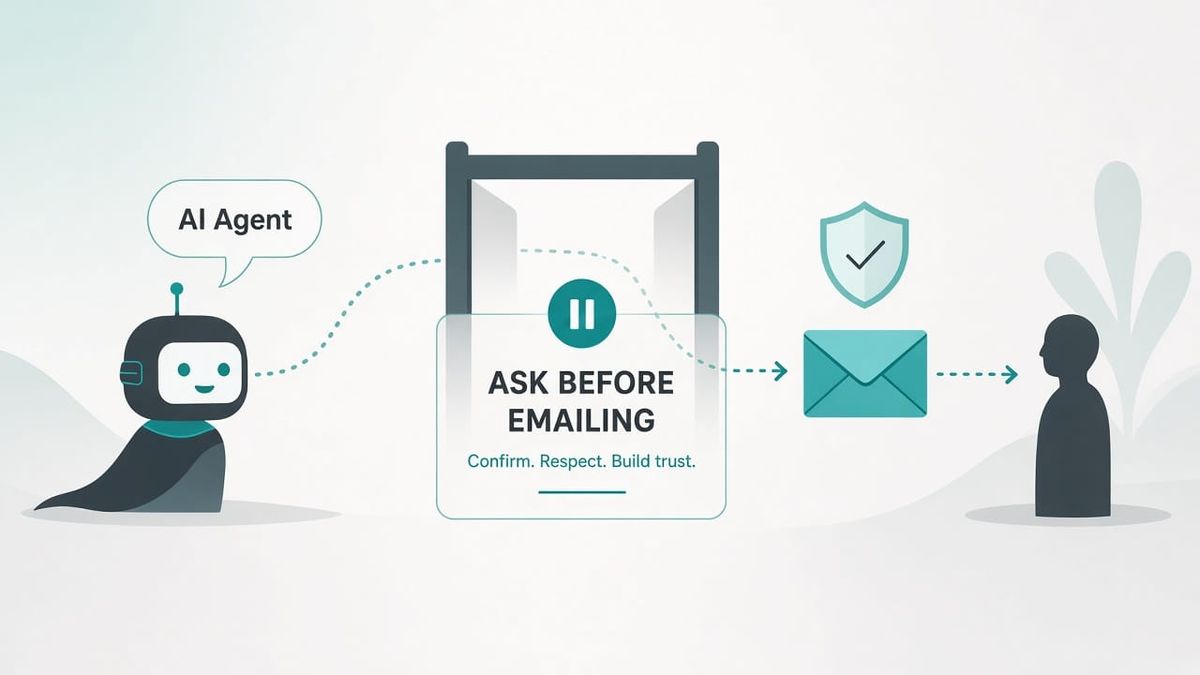
The email that nobody meant to send
It usually starts with a useful workflow.
A lead fills in a form. A customer asks a question. A deal moves stage. An AI draft looks sharp, so the team connects it to the live inbox “just to save time”. The first few sends go well. Then one does not.
The message goes to the wrong person. Or the right person, with the wrong offer. Or a polite follow-up that contradicts what a human already promised on a call. Or a reminder about a cancelled order. Or a confident reply based on an outdated customer status.
Nobody sat down and chose that outcome. The system simply did what it was allowed to do: it sent.
This is not mainly a writing problem. It is an appr
oval-boundary problem. Outbound AI without an explicit confirm gate can turn a draft into a customer commitment before anyone has clearly said yes.
Reframe: a customer send is a commitment
Internal notes, summaries and task suggestions can be revised quietly. A customer email cannot.
Once it leaves, it carries the business with it: tone, offer, timing, facts and implied next steps. It creates an expectation. It may create a record that sales, support or finance later have to honour. Even polished wording can leave an expensive mess to unwind.
So the standard should not be, “Can the AI write a good email?” The standard should be, “Can this workflow contact a customer only after a person has confirmed the send, with enough context to own the result?”
Silent send feels efficient. It is also a governance gap. Efficiency that skips ownership is not operational maturity; it is deferred damage.
What breaks when outbound AI sends alone
When an AI system can email a customer without asking, several consequences follow quickly.
Ownership disappears. After a bad send, teams argue about who approved it. The log may show that a message went out, but not who accepted the recipient, content, timing or commercial risk. Without a recorded yes, blame drifts and learning stalls.
Memory becomes a liability. AI is useful because it can use prior context. That same memory can be wrong, incomplete or stale. A workflow that recalls an old discount, earlier complaint or previous stage can write a convincing message from bad assumptions. Memory without a confirm gate accelerates error.
Trust thins on both sides. Customers experience one business, not a stack of tools. Staff lose confidence when they cannot predict what will go out under the company name. Leaders lose a clean picture of what was promised and by whom.
Recovery costs more than drafting ever saved. Clarifying emails, credit notes, apology calls and internal rework rarely fit in the original automation business case. The cheap send becomes the expensive incident.
The deeper issue is boundary design. If outbound action does not require an explicit ask, the system treats customer contact as a default side effect rather than a controlled decision.
Practical standards for an ask-before-send gate
A reliable outbound workflow should make the confirm step visible, hard to skip and easy to audit.
1. Separate draft from send
Drafting can be automatic. Sending should not be. Keep a clear state between “ready to review” and “allowed to leave”. A person should see the recipient, subject, body and key facts before the workflow can transmit.
2. Make the yes specific
A vague “looks fine” is weak governance. A useful confirm answers: Who is receiving this? What are we saying? What offer or commitment does it contain? Is the customer status current? Who is accountable if this is wrong?
Record that confirmation against the draft. Do not assume it from the existence of a workflow.
3. Attach ownership to the send
Every customer-facing send needs an owner: the person who confirmed it, or the role authorised for that message type. Ownership decides who reviews exceptions, who updates the rule and who speaks to the customer if repair is needed.
4. Bound memory, destinations and the audit trail
Define which fields may shape outbound copy and which require a fresh check. Stale stage, unpaid invoice, cancelled booking, open complaint or changed contact details should pause the send, not decorate it. Memory should support the decision; it should not silently authorise the send.
Use allow-lists where practical: approved domains, known contacts, internal preview recipients in testing, and restricted templates for refunds, discounts or contractual changes. The more irreversible the action, the tighter the gate.
Afterwards, a manager should reconstruct what was drafted, what changed, who confirmed, when it went out and which record it referenced. If that story cannot be told, the workflow is not ready for live outbound work.
Five questions before outbound AI goes live
Before an AI workflow is allowed to email or otherwise contact a customer, answer:
- What exactly requires a human confirm before send?
- Who is allowed to give that confirm, and for which message types?
- What context must be visible at the moment of approval?
- What customer-state changes should block or pause the send?
- How do we stop a bad draft, revoke a mistaken approval path, and repair a sent message?
If those answers are fuzzy, the workflow may be good at drafting and still unsafe on a live customer channel.
I treat this as an operating-system question, not a copywriting upgrade. The business needs a clear approval boundary around customer contact, with ownership and memory held inside that boundary.
Walter POV: governance before velocity
At Walter, I am focused on helping businesses run AI work with clearer ownership, shared context and visible hand-offs. Outbound messaging is one of the sharpest tests of that design.
A useful assistant can prepare the work. A trustworthy operating layer decides when the work is allowed to leave the building: confirm gates, accountable owners, current customer context and an inspectable record of what happened.
Speed still matters. Put friction where the risk is — at the moment a message becomes a customer commitment. Teams move faster when they trust that silent send is not lurking behind a convenient toggle.
If your AI can email a customer without asking, change the rule before you scale the workflow.
Keep drafting helpful. Make send explicit. Show the person what will go out. Record the yes. Bound outbound memory. Limit high-risk destinations and promises. Review the first live sends more carefully than the demo.
Do that, and outbound AI becomes an assistant inside a governed process rather than an unsupervised representative of the brand.
Join the waitlist at https://hirewalter.ai/



